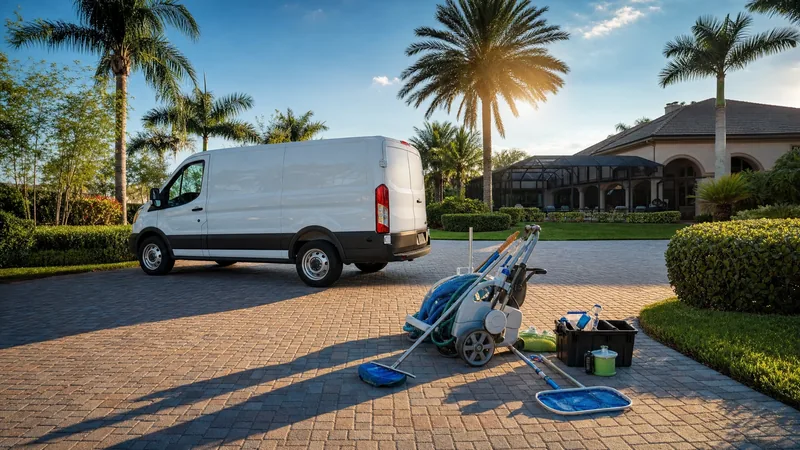
How to Start a Pressure Washing Business in Florida
How to Start a Pressure Washing Business in Florida
Pressure washing is one of the more accessible service businesses you can start in Florida. Startup costs are modest compared with many trades, your customers can include homeowners, property managers, and commercial clients, and Florida does not issue a state license for pressure washing. What you do need is a clean legal setup, the right local tax registrations, insurance that clients will accept, and a wash water plan that keeps you clear of stormwater rules.
This guide walks through the process in the order most new owners complete it. Where a figure depends on your county or city, we say so and point you to the agency that can confirm it.
Disclaimer: This article is informational content, not legal or tax advice. Your entity choice, tax treatment, and insurance decisions affect your personal finances and liability, so talk with a Florida attorney and a certified public accountant (CPA) before you file.
Do You Need a License for Pressure Washing in Florida?
This is the question most people search for first, so here is the direct answer. Florida does not issue a state pressure washing license. It also does not issue a general statewide business license. The Department of Business and Professional Regulation (DBPR) licenses specific professions and trades, but pressure washing is not a state-licensed trade.
The local rule is more specific than most people expect. Under s. 489.117(4)(a), Florida Statutes, pressure washing is among the job scopes that local governments may not license. In practical terms, a city or county cannot require you to hold a local competency license just to pressure wash. Local governments still administer other requirements, so confirm the current status with the building or licensing office in each jurisdiction where you plan to work.
Two local obligations are often confused with a license:
- Local business tax receipt (BTR). A BTR is a tax under Chapter 205, Florida Statutes, required for the address where you operate. It is not proof of skill or training. Not every county or city levies one, so check with your county tax collector and, if you work inside city limits, with the city.
- Sales and use tax registration. Florida's state sales tax rate is 6%. Businesses selling taxable goods or services must register as a sales and use tax dealer with the Florida Department of Revenue before beginning business. Whether a particular pressure washing service is taxable depends on the service, so confirm it with the Department of Revenue before you quote your first job.
If you plan to add roof cleaning, gutter work, or other services beyond surface washing, do not assume the same answer applies. This guide covers pressure washing only, so confirm those services separately before you add them to your menu.
Materials and Equipment You Need Before Day One
Equipment prices vary widely by pump type, engine or motor, and brand, and this guide does not quote them. Get current prices from suppliers before you set a budget. Build your kit around the surfaces you plan to clean first, then add tools as your client list grows.
- A pressure washer sized for your target work, plus spare parts and a basic maintenance kit for the pump.
- A surface cleaner attachment for flat concrete and driveways, which cleans faster and more evenly than a wand.
- Spray wands and nozzle tips, typically ranging from 0 degree (most aggressive) to 40 degree (gentlest).
- High-pressure hose, quick-connect fittings, and a hose reel.
- A low-pressure soap system or pump sprayer for detergents and pre-treatment products.
- A water source, plus a tank or temporary supply where outdoor hose bibs are not available.
- Wash water containment, such as vacuum recovery, berms, or a surface cleaner with recovery, depending on the job.
- A truck or trailer that carries the unit securely, plus a ladder or extension wand for multi-story work.
- Personal protective equipment: eye protection, gloves, closed-toe boots, and hearing protection for gas engines.
- Business documents: a written estimate and service agreement template, a photo checklist for before and after shots, a waiver for older or fragile surfaces, and invoicing software.
Step-by-Step: Starting Your Pressure Washing Business in Florida
Step 1: Choose Your Legal Structure
Most one-person service businesses in Florida choose between a sole proprietorship and a limited liability company (LLC). A sole proprietorship requires no state formation filing, but you are personally responsible for business debts and claims. An LLC separates your personal assets from the business, which matters for a service that carries property damage risk. A corporation is also an option, but for most small washing businesses it adds cost without a clear benefit.
The state filing fees differ by structure. An LLC's Articles of Organization cost $125 in total, including the $25 registered agent designation. A Florida profit corporation's Articles of Incorporation cost $70 in total, including the $35 registered agent designation. A single-owner LLC is generally treated as a disregarded entity for tax purposes and generally does not file a Florida corporate income tax return. An LLC classified as a corporation for federal tax purposes pays the 5.5% Florida corporate income/franchise tax. Confirm which applies to you with a CPA, because tax treatment depends on how the entity is classified and who owns it.
Step 2: Check and Reserve Your Name
Search the Florida Division of Corporations database before you settle on a name: Sunbiz name search. An LLC name must end with “Limited Liability Company,” “LLC,” or “L.L.C.” and must be distinguishable from names already on the state's records. If you need to hold a name while you prepare your paperwork, you can reserve it for 120 days for $25 through the Division. Do not treat a name as approved until you receive a filing acknowledgment. More reservation details are in the Division's FAQs.
Step 3: File Your Articles of Organization
File online through Sunbiz eFile for $125. The Division does not offer expedited filing, and it publishes no guaranteed turnaround time. Online filings are processed in the order received, and images of electronically filed documents post within 3 business days of processing. If timing matters, walk-in service is the practical alternative. It is available at 2415 N. Monroe Street, Suite 810, Tallahassee, Monday to Friday, 8am to 5pm, and most requests are completed while you wait. Plan for the trip if you need the filing done in a single visit.
Step 4: Appoint a Registered Agent
Every Florida LLC must designate a registered agent with a physical street address in Florida. A P.O. box is not allowed. The agent must sign the filing to accept the appointment. An LLC cannot serve as its own registered agent, but you or another individual owner or officer can. The designation carries a required $25 fee for an LLC, and changing the agent later costs the same $25. Commercial registered agent services charge their own fees on top of the state's $25, so compare the total before you sign up.
Step 5: Get a Federal EIN and Open a Business Bank Account
Apply for a federal Employer Identification Number (EIN) through the Internal Revenue Service. Banks and many commercial clients ask for it. Open a separate business checking account and run all client payments and equipment purchases through it. Mixing personal and business funds weakens the liability separation an LLC provides and makes your bookkeeping harder.
Step 6: Get Your Local Business Tax Receipt
Check with the county tax collector for the address where you will operate, and with the city if you are inside city limits. Ask whether a BTR applies at all, because not every jurisdiction levies one. If you run the business from home, ask the local zoning office whether a home-based business is permitted before you apply. Keep the receipt with your business records.
Step 7: Register for Sales Tax if It Applies
If your services are taxable, register as a sales and use tax dealer through the Florida Department of Revenue registration page before you begin business. The state rate is 6%, but local rates can differ, so confirm the rate that applies in each county where you bill customers.
Step 8: Register a Fictitious Name if You Use One
If you operate under a name other than your legal name or your LLC's name, such as “Sunshine Surface Care,” file a Fictitious Name Registration with the Division of Corporations. Registration costs $50 and renewal costs $50. A registration is valid for 5 years and expires on December 31 of the fifth year. You renew between July 1 and December 31 of the expiration year. Florida requires the name to be advertised at least once in a newspaper in the county of your principal place of business, though no proof of advertisement is filed. The filing is statewide, not county-level. File through the Sunbiz fictitious name registration page.
Step 9: Buy Insurance Before You Bid on Commercial Work
Insurance is where many new washers lose contracts. Property managers, homeowners associations, and commercial clients often ask for a certificate of insurance before they sign. Ask carriers about general liability coverage and how their policies treat property damage claims on surfaces such as stucco, painted siding, and older concrete, since those are common complaint areas. Ask whether the policy also covers your equipment and vehicle. Get quotes from several carriers and ask for the limits and exclusions in writing. If you plan to hire helpers, ask your insurance agent and the Department of Revenue which employer obligations apply, because they differ from a solo operation. This guide does not quote insurance costs, since they depend on your coverage and risk profile.
Step 10: Set Up Pricing, Contracts, and Job Documentation
Price by surface area and difficulty rather than by hour alone. Write the scope into every estimate: which surfaces get washed, which get surface cleaner, what pre-treatment is included, and what is excluded, such as roof chemical treatment or sealing. Use a signed service agreement that states who is responsible for vehicles, landscaping, and water access. Photograph each surface before and after. Those photos protect you when a client disputes the result, and they become your best marketing material.
Step 11: Calendar Your Annual Report
An LLC must file an Annual Report each year between January 1 and May 1 for $138.75. Reports received after May 1 carry a $400 late fee, bringing the total to $538.75. An LLC that fails to file by the third Friday in September faces administrative dissolution. Put the May 1 deadline on your calendar the day your Articles are filed. A corporation files a Profit Annual Report for $150 on the same January 1 to May 1 schedule, and a $400 late fee applies after May 1, bringing the total to $550.
Stormwater and Wash Water Rules
Florida's stormwater and runoff rules apply to what leaves your job site, and local rules can be stricter than the state baseline. Soapy wash water that enters a storm drain generally flows untreated to a nearby canal, lake, or bay. Letting wash water run into the street is one of the most common ways pressure washers create a compliance problem, so plan containment before your first job.
Build these practices into every job:
- Use surface cleaners with recovery or vacuum recovery on driveways and walkways where practical.
- Keep wash water away from storm drains, curbs, and waterways. Use berms, sandbags, or drain plugs where runoff could reach a drain.
- Choose detergents labeled for the surface and for use near landscaping or water features, and follow the label directions exactly.
- Do not wash over fuel, oil, or paint residue without a containment plan, and confirm how collected water must be disposed of.
- Ask each city and county where you work how it handles wash water and stormwater, and confirm the answer with the local stormwater or environmental division.
Common Mistakes to Avoid
- Assuming no license means no paperwork. The absence of a state license does not remove local tax, zoning, or stormwater obligations.
- Acting on an unapproved name. Wait for the filing acknowledgment before printing signs, trucks, or contracts with your LLC name.
- Using a P.O. box as the registered agent address. Florida requires a physical street address in Florida.
- Missing the May 1 annual report deadline. A late report adds $400, and an LLC that stays unfiled into September risks administrative dissolution.
- Quoting jobs without a written scope. “Wash the house” is a dispute waiting to happen.
- Skipping the sales tax question. Confirm whether your services are taxable before you bill customers.
- Running full pressure on soft or painted surfaces. Test a small, hidden area first, especially on wood, older stucco, and painted siding.
- Letting wash water reach storm drains. This is the fastest way to create a stormwater problem.
- Underpricing to win early jobs. Low prices can leave you unable to cover equipment repairs, fuel, and insurance.
- Buying insurance after a commercial lead asks for it. Get coverage in place before you bid so you can answer the request the same day.
What Results to Expect
A pressure wash can help restore the appearance of driveways, walkways, siding, and patios, and it can remove loose dirt, mildew, and many surface stains. Results depend on the surface material, the age and type of staining, the detergent and dwell time used, and how the surface was maintained. A single wash may not remove every stain, and some stains may return. High pressure can also cause wear on older concrete or painted wood, which is why a test patch matters.
When you write estimates, describe what you expect to do and the conditions that can limit the result. Avoid promises such as guaranteed permanent removal, a stain that will never return, or a surface that will be protected from future damage. Hedged wording protects both you and the client, and it keeps customer expectations aligned with what the job can deliver.
Startup Costs at a Glance
| Item | Cost | Notes |
|---|---|---|
| LLC Articles of Organization | $100 | Filed through Sunbiz eFile; $125 total with the registered agent designation |
| LLC Annual Report | $138.75 | Due January 1 to May 1 each year |
| LLC late annual report fee | $400 (total $538.75) | Applies to reports received after May 1 |
| Corporation Articles of Incorporation | $35 | Florida profit corporation; $70 total with the registered agent designation |
| Corporation Profit Annual Report | $150 | Late fee of $400 after May 1 (total $550) |
| Name reservation | $25 | Holds a name for 120 days |
| Registered agent designation, LLC | $25 | Same fee to change the agent later |
| Registered agent designation, corporation | $35 | Same fee to change the agent later |
| Fictitious name registration | $50 to register, $50 to renew | Valid 5 years |
| Local business tax receipt | Varies | Confirm with your county tax collector or city |
| Sales tax registration | No fee | Confirm applicability with the Department of Revenue |
| Equipment and insurance | Varies | Get current quotes |
Official Resources
- Florida Department of State, Division of Corporations (Sunbiz): formation, annual reports, and fictitious names
- Florida Department of Revenue: sales and use tax registration and questions
- Florida SBDC Network: small business advising
- SBA South Florida district office: small business resources for South Florida owners
Starting a pressure washing business in Florida is a straightforward process once you know which filings apply to you. Confirm the local business tax receipt, sales tax treatment, and stormwater rules for every city and county you plan to serve, and talk with a qualified attorney and CPA before you commit to a structure. This article is informational content, not legal or tax advice.
Keep exploring: related Florida guides
- How to Start a Pool Cleaning Business in Florida
- How to Start a Cleaning Business in Florida
- How to Start a Pest Control Business in Florida
- How to Start a Junk Removal Business in Florida
- How to Get a Contractor License in Florida
- How to Start an LLC in Florida
- Florida Business License
- How Much Does It Cost to Start a Business in Florida
- All Florida business types
- Every Florida guide in one place